Who am I?
Most families come to me exhausted, overwhelmed, and unsure what to try next. For sixteen years I’ve supported families through newborn care and pediatric sleep, helping them understand their child’s individual sleep needs and find an approach that works for the whole family.

Founder, Sound Sleep 4 Bubbies · Pediatric Sleep Health Consultant
Pronounced with a soft “SH”.
I have worked with thousands of families in that time. Asking for help with your baby’s sleep is an unusually personal thing to do. It involves your child, your nights and how your whole household functions. I am conscious of what families are trusting me with, and I work accordingly.
My career began in overnight and daytime newborn care, with professional training in newborn care, sleep and postpartum support. I later expanded my focus into pediatric sleep, completing further education through Sleep Sense and the Sleep Health Organization.
For four years I served as the English Sleep Expert for the Kinedu app, providing weekly infant-sleep education and live courses to families around the world. I continue to develop my practice through professional conferences, current research and continuing education.
My work is temperament- and nervous-system-led rather than method-led. Across sixteen years the finding has been consistent: outcomes depend far more on the individual child, on how they are wired and how much support they require in order to settle, than on any particular sleep method.
I specialize in birth through six years, and support families from pregnancy through early adolescence. I work in person across the Seattle area and remotely with families worldwide.
A little more about me
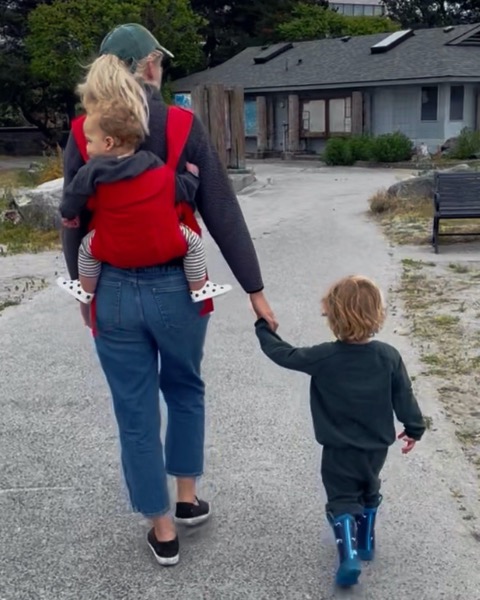
I live in the outer Seattle area with my husband, our two sons, a dog and two guinea pigs.
My own children are the clearest test of the argument I make professionally. They have very different temperaments. Both sleep well. That came from intention and consistency rather than from any single method, which is exactly what I tell the families I work with.
Neither of them had an easy start. Between them we dealt with tongue ties, latch difficulties and feeding problems. I understand how readily those become the reason sleep gets set aside, and I know they are not one. They change the order of the work, not whether it happens.
Becoming a parent also changed how I understand the work. I had spent years on overnight shifts with other people’s newborns, and none of it prepared me for the cumulative fatigue of parenting my own. That informs every plan I write: the household has to be able to sustain it.
Sleep is not simply rest. In the early years it underpins development, growth, emotional regulation, and a parent’s capacity to function day to day. That is why I treat it as a health matter rather than a behaviour problem.
How I work with families
Every child brings a different temperament, developmental stage and home environment. Any plan that ignores those is guessing, which is why generic sleep advice fails so often.
My role is not to hand you instructions. It is to give you a working understanding of how your child sleeps, why the current patterns formed, and which adjustments will move them. A parent who understands the reasoning makes better decisions at 3am than a parent following a script.
None of this requires ignoring your child or allowing prolonged crying. Children can learn sleep skills while still receiving comfort and reassurance, and that is the standard I work to.
I work one-to-one, building each plan around the child and then fitting it to the household. Engagements range from a single consultation to several weeks of coaching, depending on how much guidance a family needs.
Sleep change is a process, not an event. It works best when parents are supported and confident in what they are doing, so the objective is not only better sleep now but the knowledge to sustain it long after we finish.
“You helped me understand her, understand sleep, and most importantly, trust myself as a mom.”
Shereen · her daughter was 7.5 months old
If you are exhausted, overwhelmed, or unsure where to start, that is what the first conversation is for.
Sound familiar?
Families come to me for all kinds of reasons. Sometimes it is one difficult part of the day. Sometimes everyone is simply exhausted and unsure what to try next.
Bedtime
Bedtime takes forever, feels unpredictable, or has become a battle.
Naps
Naps are short, inconsistent, or difficult to settle into.
Night waking
Your child wakes frequently, needs feeding or support to resettle, or struggles to stay asleep.
Sleep habits & transitions
Rocking, feeding, holding, pacifiers, room transitions, or something else that no longer feels sustainable for your family.
None of this is a reflection of your parenting. Temperament is wiring your child came with, not something you caused, and sleep skills can be learned. You do not have to work it out alone.
“I never felt judged or like I was ‘just another client.’”
Shereen · after her coaching weeks ended
Free, and no obligation. Just tell me how your days and nights are going.
Education & training
Plus ongoing continuing education (sleep conferences, current research and CEU credits) so the support families receive stays evidence-based and developmentally appropriate.